
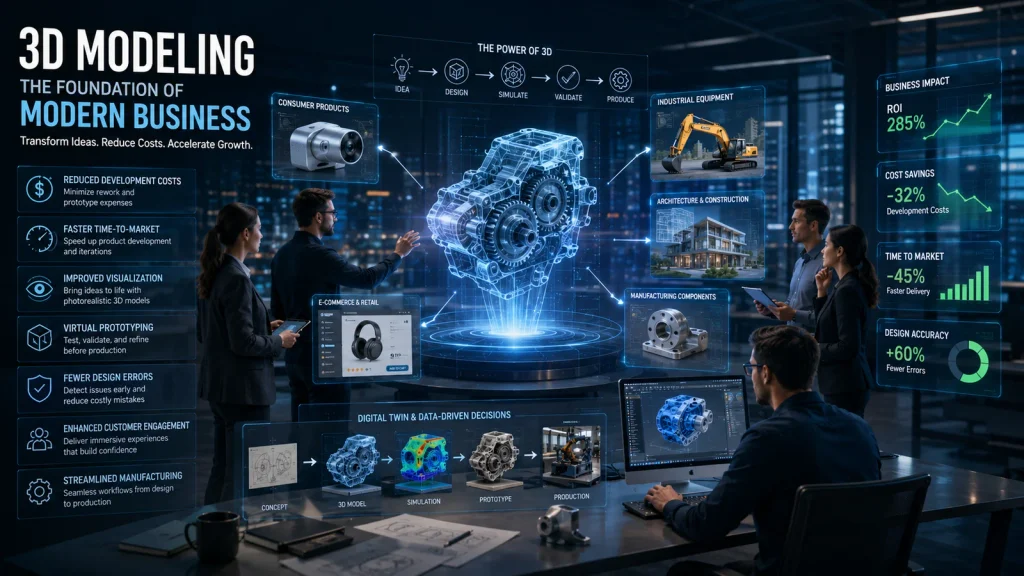
Introduction
Online shopping has one persistent weakness: customers cannot touch, rotate, or walk around a product before buying. Flat photos show only the angles a photographer chose, and generic illustrations rarely match the real item. 3D modeling and computer graphics close that gap by letting brands present products as interactive, realistic, three-dimensional assets — on product pages, in ads, in augmented reality, and in animated campaigns.
As web browsers and phones handle real-time 3D content smoothly, these techniques have moved from premium agencies to mainstream digital marketing. This blog explains what 3D marketing assets are, why they improve performance, and how brands can start using them.
What Are 3D Modeling and Graphics in Marketing?
3D modeling is the process of building a digital three-dimensional representation of a product, character, or environment using specialized software. 3D graphics are the visuals produced from those models — rendered images, animations, interactive viewers, and augmented-reality (AR) experiences.
Common marketing applications include:
- Photorealistic product renders: high-quality images created digitally instead of in a physical photoshoot.
- 360-degree and interactive product viewers: models that rotate in the browser as the user drags.
- 3D product configurators: tools that let customers swap colors, materials, sizes, or components and see changes instantly.
- Augmented reality (AR) placements: models viewed through a phone camera at real scale in a room or on the user.
- CGI animations and motion graphics: animated product reveals, explainers, and social-media clips.
- Concept and packaging visualization: previews of products or packaging before manufacturing.
Tools commonly used include Blender, Cinema 4D, Autodesk 3ds Max and Maya, Substance Painter, and AR platforms such as Adobe Aero; web-friendly formats include GLB, glTF, and USDZ.
Why 3D Modeling and Graphics Are Important in Digital Marketing
1. They significantly increase conversion rates
The strongest business case for 3D is performance on product pages. Shopify platform data, reported across e-commerce industry sources, shows that merchants adding 3D content to product pages see an average conversion lift of roughly 94%, and Shopify has also reported conversions roughly doubling when products are presented with 3D and AR experiences. Interactive 3D configurators have been reported to lift conversions anywhere from 27% to over 300%, depending on the product category and configurator complexity.
The mechanism is straightforward: shoppers who can inspect a product from every angle understand it better and buy with more confidence.
2. They reduce product returns
Returns are expensive — they cost shipping, restocking, and reputation. 3D and AR visuals remove the uncertainty that causes mismatched expectations. Industry reports indicate that products with interactive 3D content generate around 40% fewer returns, while AR try-on and in-space placement can reduce returns by roughly 25–48% in fit-heavy categories such as furniture, apparel, and footwear. IKEA’s AR placement app, IKEA Place, was reported to increase conversions by about 14% while cutting returns by around 23%.
3. They remove purchase uncertainty before checkout
A flat photo cannot show scale, texture, seams, or how parts connect. A 3D model lets customers examine details, view the interior or underside, and see the product in real context. Reports from retailers using AR note that shoppers who use AR features — such as fashion brand Rebecca Minkoff’s virtual try-on — can be roughly 65% more likely to place an order, because the experience answers the unspoken question, “Will this actually work for me?”
4. They create immersive, differentiating experiences
Interactive 3D and AR stand out in feeds dominated by identical static photos. A customer who rotates a model, customizes its finish, or places it in their home spends more time engaged with the product, and that deeper engagement strengthens both recall and intent. For brands competing on design — furniture, eyewear, cosmetics, electronics, automobiles — 3D content is increasingly a baseline expectation rather than a novelty.
5. They elevate brand perception and visual quality
CGI renders match or exceed photoshoot quality while offering complete control over lighting, materials, backgrounds, and scenes. Premium-looking visuals signal quality and professionalism, supporting the brand’s positioning and premium pricing. Animated 3D sequences also make ads and social content feel modern and polished.
6. They are flexible and cost-efficient over time
A single 3D model is a reusable asset. It can be rendered into catalog images, social posts, website viewers, AR experiences, ad creatives, and trade-show visuals without repeated physical photoshoots. Brands can visualize new colors, variants, or packaging before production, reducing wasted inventory and photography costs. For products still in development, CGI also enables marketing campaigns to launch before the physical sample exists.
7. They power personalization and interactive advertising
Configurators let customers co-create the exact product they want, which increases both engagement and average order value. Interactive 3D ads and AR filters on social platforms also generate higher interaction rates than standard image ads, giving paid campaigns a stronger creative edge.
8. They are future-proof for the evolving web
Real-time 3D runs in most modern browsers through WebGL, and AR increasingly works without a downloaded app. As platforms adopt spatial computing and more immersive shopping formats, brands that already maintain 3D asset libraries will be able to deploy them quickly, rather than rebuilding from scratch.
Common Use Cases in Digital Marketing
- E-commerce product pages: interactive 360° viewers and AR placement for furniture, appliances, and accessories.
- Paid social and search ads: CGI product animations and interactive 3D ad formats.
- Product customization: configurators for footwear, eyewear, furniture, and electronics.
- Brand campaigns: cinematic CGI reveals and animated explainers for launches.
- Packaging and concept testing: visualizing packaging designs and new products before manufacturing.
- Retail and catalogs: consistent, high-quality imagery across web, mobile, and marketplaces.
How to Get Started with 3D Content
- Prioritize hero products. Start with best-selling, high-margin, or high-return items where visualization matters most.
- Choose the right format. Use renders for ads, interactive viewers for product pages, and AR for size- or fit-dependent categories.
- Optimize for performance. Heavy models slow pages and hurt conversions; compress files, use efficient formats, and load 3D on user interaction.
- Maintain a reusable asset library. Build models once and reuse them across channels and campaigns.
- Measure the right metrics. Track conversion rate, add-to-cart rate, return rate, time on product page, and engagement with the 3D viewer.
- Combine with strong storytelling. 3D visuals show the product; copy, narrative, and reviews supply the reasons to buy.
Challenges to Plan For
- Upfront production cost: high-quality modeling requires skilled artists or specialized platforms, though costs have fallen with accessible tools and outsourcing options.
- Technical performance: models must be optimized for mobile and fast page loads.
- Consistency: 3D assets should match the real product accurately to avoid return-related disappointment.
- Team skills: learning modeling software or choosing a vendor requires a small upfront investment in capability.
Conclusion
3D modeling and graphics have become a practical performance tool in digital marketing, not just a creative luxury. They help customers understand products better, buy with confidence, return fewer items, and remember brands more vividly. The data points consistently in one direction: interactive 3D and AR content lifts conversions, reduces returns, and makes advertising more engaging.
For most businesses, the best starting point is narrow and measurable: select a few key products, create accurate 3D assets, deploy them on high-traffic pages, and compare conversion and return rates against static imagery. As results accumulate, the same models can be expanded into ads, configurators, and AR experiences. In a visual-first digital economy, showing products in three dimensions is becoming the standard way to sell them.
Key Takeaways
- 3D content helps shoppers inspect, customize, and place products realistically, reducing uncertainty before purchase.
- Reported results include conversion lifts of roughly 94% on product pages, double conversions with 3D/AR experiences, and 25–48% fewer returns from AR applications.
- One 3D model can be reused across renders, viewers, ads, configurators, and AR, improving long-term cost efficiency.
- Start with high-impact products, optimize for mobile performance, and measure conversion and return-rate changes directly.
Written by Dinoth Oshan (Digital media exective)